
Most store owners ask this question about three months in. By then they have spent money, seen a few changes, and still aren’t seeing their products rank. It’s a fair question, and the honest answer depends on where the store starts.
The short answer
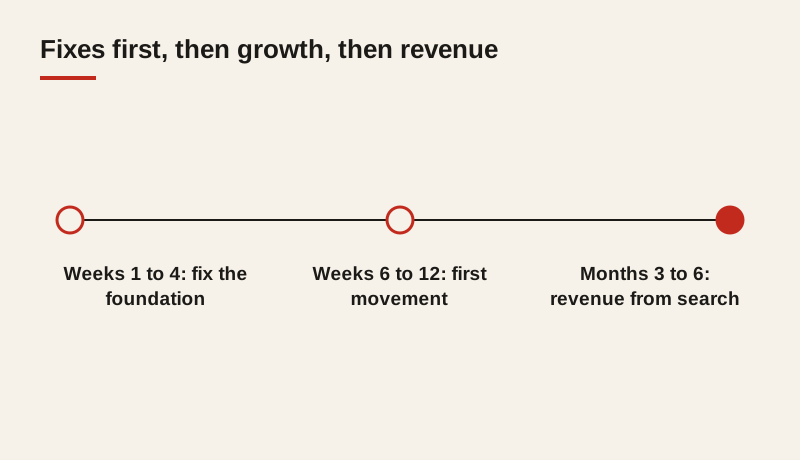
For most ecommerce stores, expect the first visible movement in six to twelve weeks, and meaningful revenue from search in three to six months. Stores with serious technical problems can take longer, because those problems have to be fixed before the content can work.
Anyone who promises rankings within a few weeks is describing a best case, or hoping you won’t check their work.
What happens in the first month
The first month is rarely about rankings. It’s about making the store readable to search engines. Google has to crawl the site and find which pages it can reach. Pages that are slow, duplicated or blocked need fixing. Page titles, descriptions and headings need rewriting, so each page has one clear job.
If you look at your rankings in month one, you’ll mostly see the same results you had before. That’s normal. The work is underneath, and it’s the part that makes everything after it possible. A good partner will be able to tell you exactly what they changed and why, even when nothing has moved yet.
What happens in months two and three
This is when movement usually starts to show. Pages that were fixed get crawled again, and product and collection pages begin to appear for the searches they were written for. If the store has buying guides, they start to attract readers who are still deciding what to buy.
Expect the numbers to move unevenly. A handful of keywords will climb first, usually the ones with less competition. Others will sit still for weeks, and that doesn’t mean the work has failed. It means the search engines are still deciding how much to trust the changes.
What changes the timeline
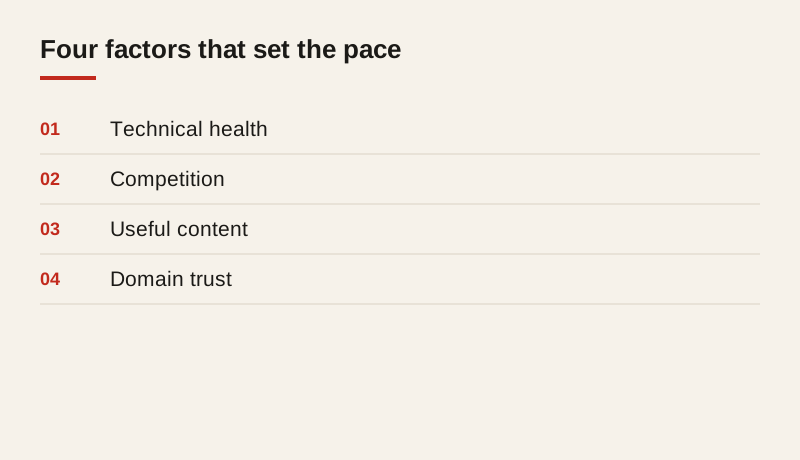
Four things decide how quickly a store moves.
- How many technical problems it has. A store with broken links, duplicate collections and slow templates has to fix those first. Until then, new content has less to build on.
- How competitive its category is. A search term that a large brand already dominates takes longer than a specific term that nobody has targeted properly.
- How much useful content it publishes. Articles that answer real questions build on each other over time. A single post rarely moves a store on its own.
- How trusted the domain is. Links from relevant sites tell search engines the store is worth showing. Those links take time to earn, and they can’t be bought quickly without risk.
Why the first three months are about fixing
It can feel backwards to spend the first months on work that doesn’t show in rankings. But search engines judge a store as a whole. If the site is slow on phones, has duplicate pages and hides its best products behind confusing navigation, new content gets less credit. Fixing the foundation first means every later change has more effect.
A useful test is to ask your partner what they expect to change in the first four weeks, and why. The answer should be specific: which pages, which problems, and what they expect to see afterward.
What a good plan looks like in the first 90 days
A good SEO partner should be able to show you, every month:
- What they fixed, and what each fix was expected to change.
- Which pages moved, and which didn’t, with the reason where they know it.
- Visits and revenue from search, not only keyword positions.
- What they plan to do next, and why it comes next.
If a report only shows keyword positions with no revenue line and no explanation, ask harder questions. Rankings matter because they lead to visits and sales. Judge the work by the sales.
A realistic way to think about the timeline
Think of SEO as compound interest rather than a switch. Each fix makes the next piece of content more useful, and each article gives the next link more to point at. The gains feel slow at the start, then faster, and they keep going after the work slows down.
That’s also why stopping early is costly. A store that gives up at month three often loses the momentum that the first fixes built.
Does a redesign reset the clock?
A redesign can speed up the timeline or slow it down, depending on how it’s done. A new theme that keeps the same addresses, page titles and internal links usually causes little harm, and it can make the store faster and easier to use. A redesign that changes every address without redirects can cost months, because search engines have to rediscover the store and rebuild trust in each page.
If you’re planning a new site, treat the redirects as part of the project, not an afterthought. Map each old address to its new equivalent, check that the important pages still exist, and keep the titles and descriptions of your best pages unless there’s a clear reason to change them. Expect a short dip in the first weeks after launch, and watch the numbers closely during that time.
Why results vary between product types
Two stores in the same category can see very different timelines. A store selling replacement parts, where each buyer searches for a specific model number, often sees faster results than a store selling fashion, where the searches are broader and more competitive. Gift stores, seasonal products and stores with strong repeat buyers can also move at different speeds, because their demand follows the calendar more than the algorithm.
This is one reason we don’t give a single number for every store. The honest answer depends on the catalog, the buyers and the competition, and a good partner should be able to explain which of those factors matter most for your business.
What to expect in the first year
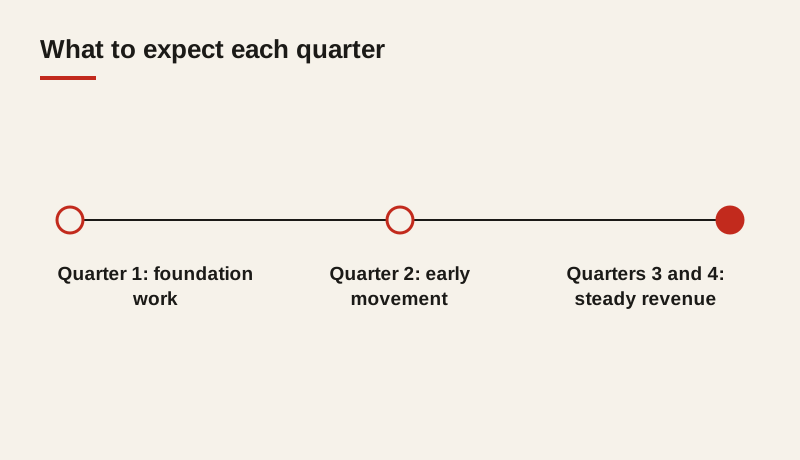
Most stores that keep working on SEO see a pattern across the first year. The first three months build the foundation, and the results are modest. Between months four and six, the best pages start to earn steady visits, and the gains become easier to see. By the end of the first year, search is often one of the largest sources of new buyers, but only if the work continued through the slow months.
The pattern is not a promise. Some stores move faster, and some take longer, usually because of a technical problem that wasn’t visible at the start. The point of the first-year view is to set expectations, so that a quiet first quarter doesn’t lead to abandoning work that would have paid off.
Where to start
The first step is an honest look at the store. That covers the catalog, the margins, the searches buyers actually make, and the technical state of the site. From there, you should get a written order of work and a rough timeline before anything is changed on the live site.
If you want a specific answer for your store, that’s what a store analysis is for. We’ll look at your products, your traffic and your competition, and give you a plan with a realistic timeline before we talk about price.
Frequently asked questions
How long before an ecommerce store sees more sales from search?
Most stores see the first visible movement in six to twelve weeks and meaningful revenue from search in three to six months. The timing depends on how many technical problems the store has and how competitive its category is.
Can I speed up SEO by paying for it?
Paid ads can bring visitors quickly, but they don’t build the organic results that keep working after you stop paying. Buying links or other shortcuts usually creates risk and can set progress back. The faster route is fixing the store’s foundations first.
What should my agency show me in the first month?
A specific list of what they checked, what they changed and what they expect to move, with the reasons. If the first month is only keyword reports with no explanation, ask for a clearer plan.
Is SEO worth it for a small store?
It can be, especially for stores with products that buyers search for by name or by problem. A smaller catalog often makes the early fixes quicker, and the work builds a base that keeps paying off.