
Search is no longer just about ranking blue links. AI systems now summarize, recommend, and decide which brands deserve visibility. Understanding what a generative engine is, and how generative engine optimization works, is essential for any business that wants long-term relevance. This guide connects the dots clearly and practically.
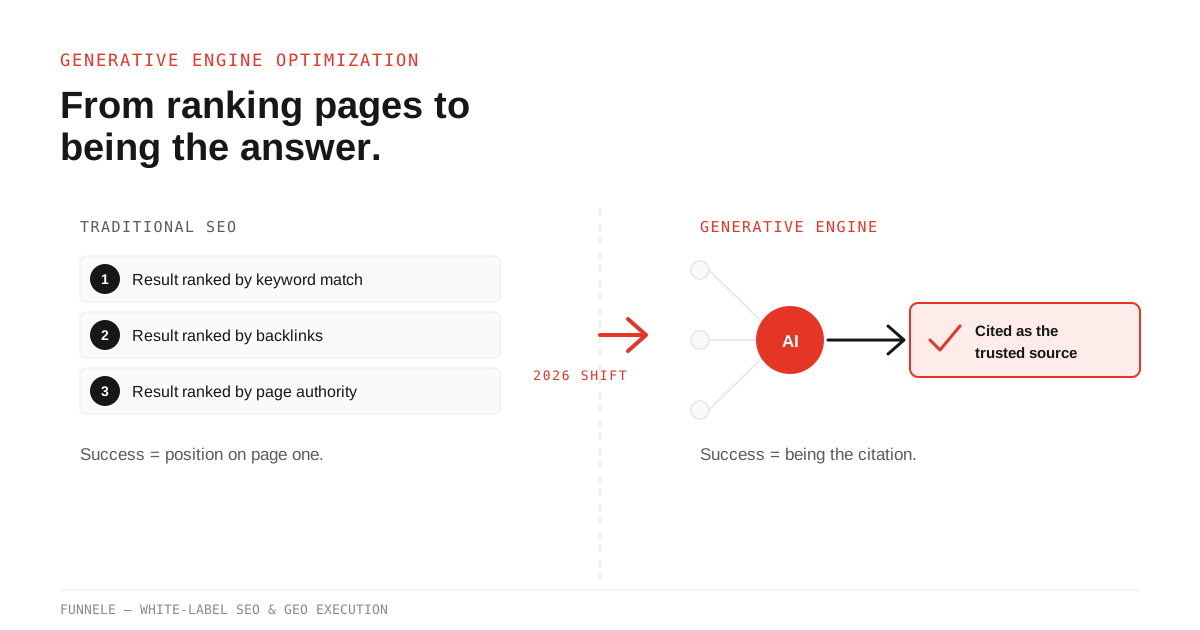
Generative Engine Optimization (GEO) is the natural next phase of search visibility — not a replacement for SEO, but an expansion of it.
What generative engines are and why they matter
A generative engine is an AI-powered system that uses context, multiple data sources, and learned patterns to generate answers, rather than simply retrieving webpages. That single shift changes what “visibility” means.
Traditional search engines match keywords and rank pages. Generative engines evaluate purpose, compare sources, and assess credibility before producing a recommendation. As a result, AI search becomes more targeted, predictive, and conversational — and optimization has to evolve to match.
From SEO to GEO: understanding the shift
SEO has prioritized rankings, backlinks, and keywords for years. Those elements still matter, but generative engine optimization goes beyond surface-level signals. The move from SEO to GEO isn’t a replacement — it’s an expansion.
The purpose of GEO is to make a brand and its content solid, approachable, and worth referencing by AI systems. Relevance, authority, structure, and contextual clarity are the real goals. That’s why AI search optimization is becoming a bigger part of marketing strategy heading into 2026.
Core concepts of generative engine optimization
At its foundation, generative engine optimization focuses on helping AI systems confidently reference a brand’s content. That means clarity, depth, and demonstrated expertise matter more than manipulation — this is where GEO strategy differs from old SEO shortcuts.
How generative engines work behind the scenes
Understanding how AI systems handle data is the first step to understanding how GEO works. Instead of producing a list of links, generative engines analyze intent, compare sources, assess credibility, and then produce a recommendation. Content that is well-organized, credible, and rich in context gets favored.
Key differences between traditional search engines and generative engines
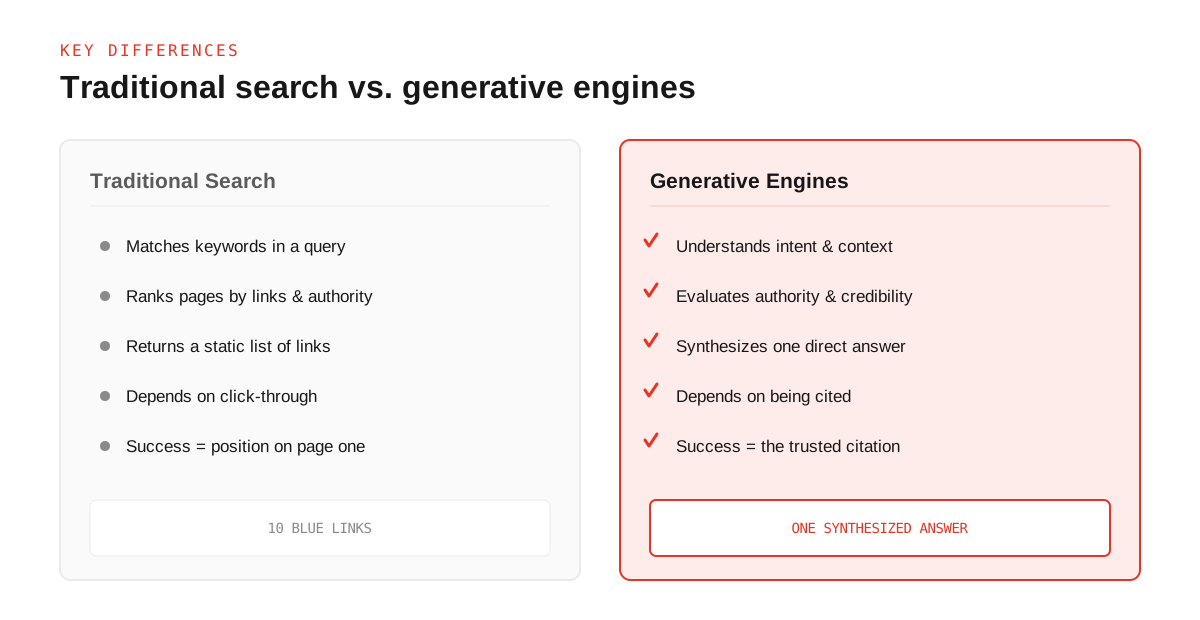
Traditional search returns a list of ten links. A generative engine synthesizes one answer — and decides whether your brand is part of it.
Once this difference is clear, the importance of GEO becomes hard to ignore.
Why optimization GEO should be a priority in 2026
The future of generative engine optimization is already unfolding. Brands that delay adoption risk becoming invisible inside AI-generated responses — this isn’t theoretical, it’s happening now.
Prioritizing generative engine optimization in 2026 means:
- Being cited as a trusted source by AI
- Increasing brand visibility beyond rankings
- Reducing dependency on traditional traffic alone
- Staying aligned with GEO best practice as it evolves
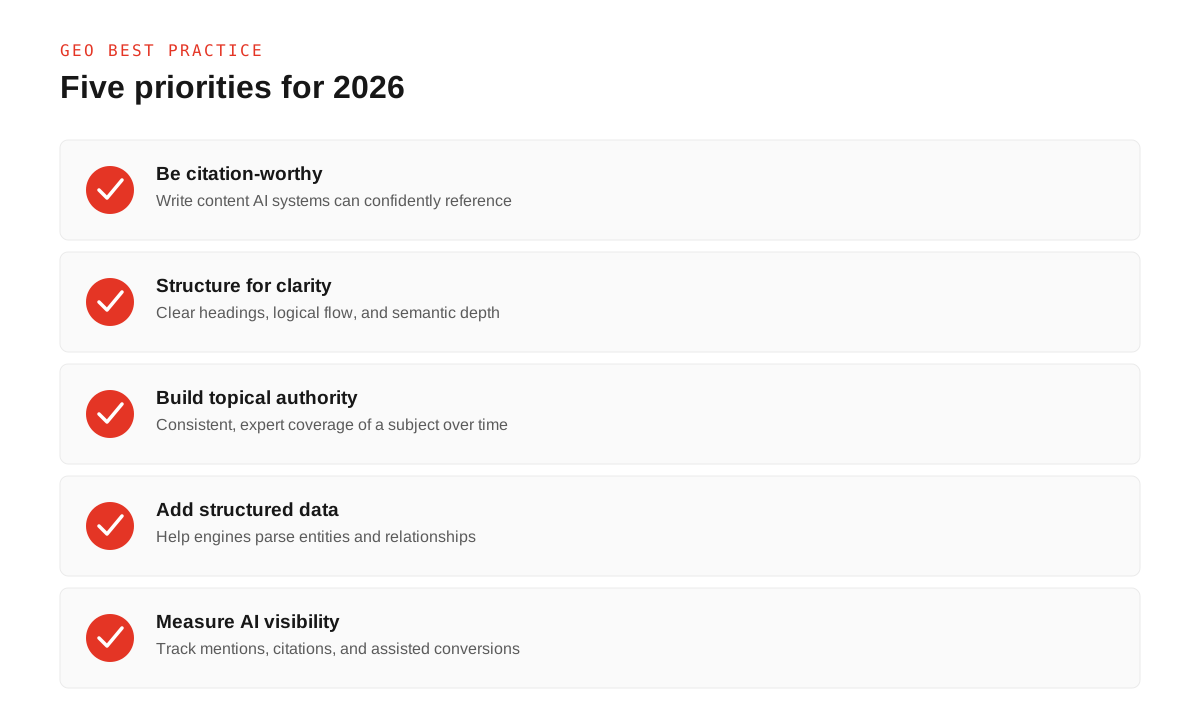
Forward-thinking teams treat GEO as a strategic investment, not an experiment.
Fundamental GEO strategies that drive results
Strong GEO strategy focuses on clarity, credibility, and structure. Instead of chasing algorithms, GEO aligns with how AI systems naturally evaluate content.
Structuring content for generative engines
Effective structure means clear headings, logical flow, and semantic depth. Content has to answer questions completely while staying easy to interpret — well-structured content is simply easier for AI to extract, summarize, and trust.
Building authority and trust in the GEO era
Building authority in the GEO era requires more than backlinks. Expertise, author credibility, consistent topical coverage, and brand mentions all contribute. Generative engines favor sources that demonstrate long-term reliability over short-term optimization tricks.
Technical and on-page considerations for GEO
Technical SEO still matters, but GEO expands it further. Clean site architecture, fast load times, and crawlability strengthen GEO outcomes alongside structured markup — these fundamentals support how AI systems interpret and extract content.
Advanced GEO techniques for a competitive edge
Once the fundamentals are in place, advanced tactics elevate performance. This is where expert-level generative engine optimization delivers compounding results.
Leveraging schema and structured data for AI visibility
Schema and structured data help generative engines understand entities, relationships, and credibility. Structured data increases the odds of being referenced accurately inside an AI-generated answer.
Linking ecosystems and earned mentions for generative engines
Strong ecosystems include earned mentions, citations, partnerships, and authoritative references. AI systems value contextual relationships — not isolated backlinks.
Measuring and iterating GEO performance
Measuring GEO performance means tracking AI visibility, brand mentions, citation frequency, and assisted conversions. Traditional analytics alone no longer tell the full story.
Common mistakes to avoid in generative engine optimization
Many brands fail by applying old SEO habits to new systems. The most common GEO mistakes include:
- Keyword stuffing without context
- Ignoring authority signals
- Publishing shallow content
- Skipping structured data
- Treating GEO as a one-time task
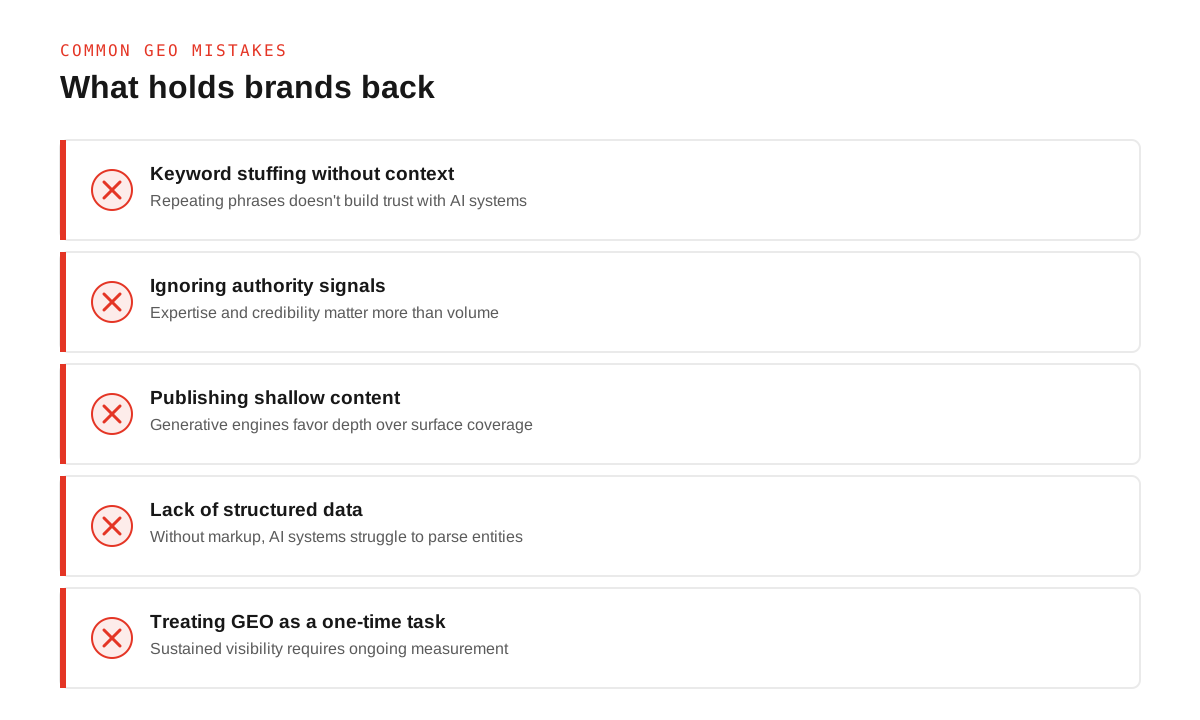
Avoiding these mistakes is what separates sustainable AI visibility from a short-lived spike.
Real-world GEO case studies and examples
Brands adopting generative engine optimization early are seeing stronger brand recall, more AI citations, and long-term authority growth. Across B2B, SaaS, healthcare, and education, GEO-optimized brands are becoming the default AI reference in their category — a pattern worth watching in our own case studies as more GEO-specific work comes through.
Step-by-step GEO implementation plan for your business
A practical GEO implementation plan includes:
- Audit existing content for AI readability
- Strengthen topical authority clusters
- Apply structured data
- Improve content depth and clarity
- Build trusted digital mentions
- Monitor AI visibility signals
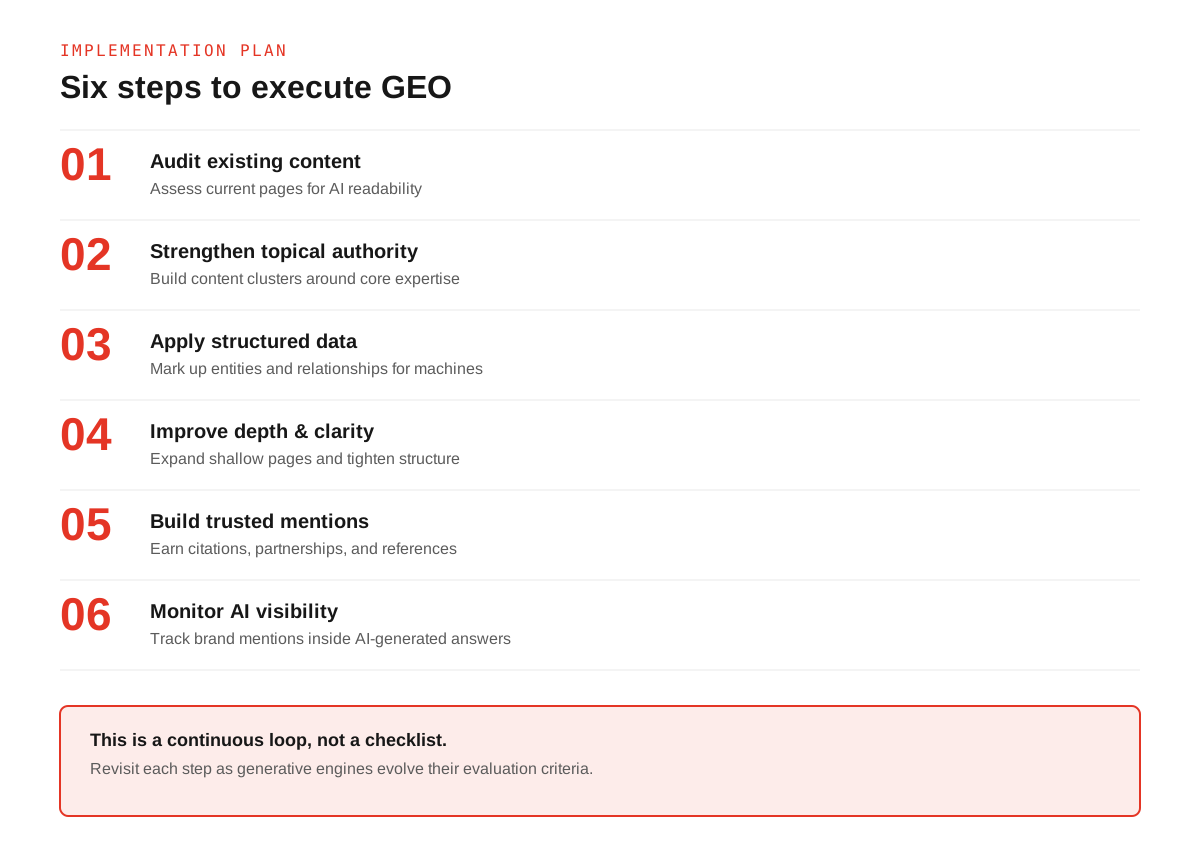
Following a clear plan is what makes generative engine SEO execution manageable instead of overwhelming.
Choosing the right GEO service provider
Selecting the right GEO service provider requires careful evaluation across a few dimensions.
Industry experience and track record
Experience across niches demonstrates adaptability to how different generative engines evaluate content.
Comprehensive GEO service offering
A strong provider covers content, technical, authority, and analytics — not just one slice of the problem.
Customized approach for your niche
Generic solutions don’t work in GEO. Strategy has to be built around the niche, not applied on top of it.
Transparent reporting and metrics
Clear performance indicators — not vague promises — are what build trust over time.
Ethical GEO practices and long-term focus
Shortcuts undermine the exact trust signals GEO depends on. Long-term focus is the only approach that compounds.
Pricing, value, and ROI
GEO is an investment in future visibility, not a line-item cost. Provider pricing should reflect that.
Conclusion: future-proofing your strategy with GEO
The shift toward generative search isn’t a trend — it’s a structural change. Businesses that understand what a generative engine is, and apply generative engine optimization thoughtfully, are positioning themselves for lasting visibility. GEO isn’t about gaming AI; it’s about earning trust, clarity, and authority.
As the future of generative engine optimization continues to unfold, brands that invest in strong foundations today will benefit tomorrow. Whether the work happens in-house or through a GEO service provider, the key is starting now.
Generative search has redefined how visibility works, making GEO essential in 2026. Unlike traditional SEO, generative engine optimization focuses on authority, structured clarity, and contextual trust. By aligning content with how AI systems interpret information, brands can secure long-term relevance inside AI-generated responses.
Successful GEO requires a strategic mindset, continuous measurement, and ethical execution. This guide provides a complete foundation, but consulting experienced professionals ensures the approach is customized to your industry. With the right approach, generative engine SEO becomes a future-proof growth system — not just a strategy.
FAQs
What exactly is generative engine optimization (GEO)?
Generative Engine Optimization (GEO) is the process of structuring content, authority signals, and technical elements so AI-powered search engines can understand, trust, and reference a brand inside generated answers. Unlike ranking pages, GEO focuses on becoming a reliable source within AI responses — visibility inside conversations, not just search results.
How is GEO different from traditional SEO?
Traditional SEO aims to rank webpages for keywords, while GEO focuses on helping AI systems synthesize and cite content. SEO optimizes for clicks; GEO optimizes for credibility, context, and authority. GEO builds on SEO but goes deeper into how AI interprets and generates information.
Can any business benefit from GEO, or is it only for large brands?
Any business can benefit from GEO, not just large brands. Smaller and niche businesses often gain faster visibility because AI favors expertise and clarity over brand size. Strong knowledge in a niche can level the playing field.
How do you measure the success of a GEO strategy?
GEO success is measured through AI visibility indicators such as brand mentions in AI responses, citation frequency, topical authority growth, and assisted conversions. Traditional traffic is still relevant, but AI-driven brand exposure and trust signals are the real benchmarks.
What are the biggest risks or pitfalls in GEO?
The biggest risks include applying outdated SEO tactics, creating shallow content, and ignoring authority-building signals. Over-optimization, lack of structure, and chasing quick wins all reduce AI trust. GEO requires patience, quality, and long-term strategic execution.
Frequently asked questions
What is generative engine optimization?
Generative engine optimization, or GEO, is the work of making a store’s pages clear, specific and trustworthy enough that AI answer tools mention or cite them. It builds on SEO rather than replacing it.
Can a store guarantee it will appear in AI answers?
No. AI tools change how they choose sources, and no partner can control the result. The sensible goal is to become the clearest and most credible source for the questions your buyers ask.
How do I measure GEO results?
Ask a fixed set of buyer questions to several AI tools each month, and record whether your store is mentioned and which sources are cited. Track the same questions over time to see the trend.
Does GEO change how I write product pages?
It reinforces good practice: state key product facts plainly, keep details consistent across pages, and answer the questions buyers ask in the first few lines.