
Most ecommerce owners choose an SEO agency the way they’d choose a plumber. They ask around, read a few reviews and pick the one that sounds confident. That works badly for SEO, because results take months to show, and a weak partner can use up a year of budget before anyone notices.
This guide gives you the questions to ask before you sign, and what a good answer sounds like. You can use them with any agency, including us.
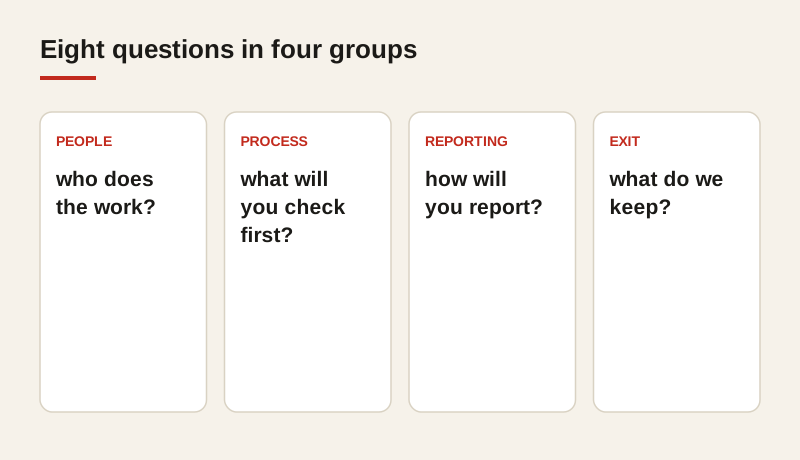
1. Who will actually do the work?
Ask who runs your account day to day, and who you’ll speak to when something goes wrong. A good agency names one accountable person and explains how the team supports them. A weak one shows you a senior name on the proposal and hands the work to people you never meet.
Ask for the name of the person who will make decisions about your store. If that person won’t join the first call, be cautious.
2. What will you check first?
A serious partner starts with the store itself: how Google reads it, how fast it loads, how the catalog is structured and what the search data says about your buyers. If the first answer is “we’ll start writing content,” ask why, before the site is understood.
A good first answer names specific checks. It mentions crawling, indexing, product page structure and the pages that already earn traffic. It should also say what they won’t do yet, and why.
3. How do you choose keywords?
Look for an answer that mentions buyer intent, competition and the real questions shoppers ask. Ask what the difficulty and volume figures are based on, and which tool they use. Ask how they’ll decide which keywords to skip, because a list of everything is not a strategy.
Be wary of any partner who promises a list of guaranteed keywords. Search results change, and no honest partner can guarantee a position on a specific query.
4. What does month one look like?
The first month is usually about fixes and setup, not rankings. Ask for a list of what they’ll check and change in the first four weeks, and what they expect to move as a result. The answer should be specific enough that you could check it yourself at the end of the month.
5. How will you report progress?
Ask for a sample report. It should show visits and revenue from search, not only keyword positions. It should also explain what changed, why it matters, and what happens next. If the sample report is a chart with no explanation, you’ll be guessing about your own business.
A useful report is short enough to read in five minutes. It should end with the next actions, and the owner of each one.
6. What do you need from my store?
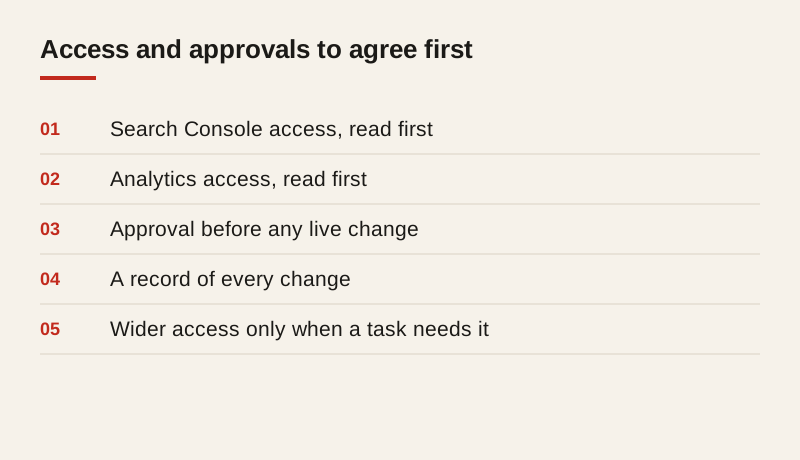
Access to Search Console and analytics is normal. Ask what they’ll change on your site, and how they handle approvals. A good partner tells you before any change goes live, and keeps a record of what was changed and when.
Be careful with any agency that asks for full admin access to everything on day one. Ask for the smallest access that lets them do the work, and widen it only when a task needs it.
7. How do you handle links?
Link building is where many agencies cut corners. Ask where links come from, how they check the sites, and whether they remove harmful links that already point to your store. Avoid any partner who guarantees a number of links, or who can’t name the kinds of sites they use.
A good answer describes relevant publications, industry blogs and directories, and explains what content or contribution earns each link. It also says how the links will be checked after they’re placed.
8. What happens if we stop working together?
Ask what you keep if the contract ends: the reports, the documentation, the changes and the access. You should own your site, your analytics and your content. You shouldn’t need the agency to keep your store working.
Ask also for the notice period, and what happens to ongoing work in progress. Clear answers here protect you if the relationship doesn’t work out.
What a good answer sounds like
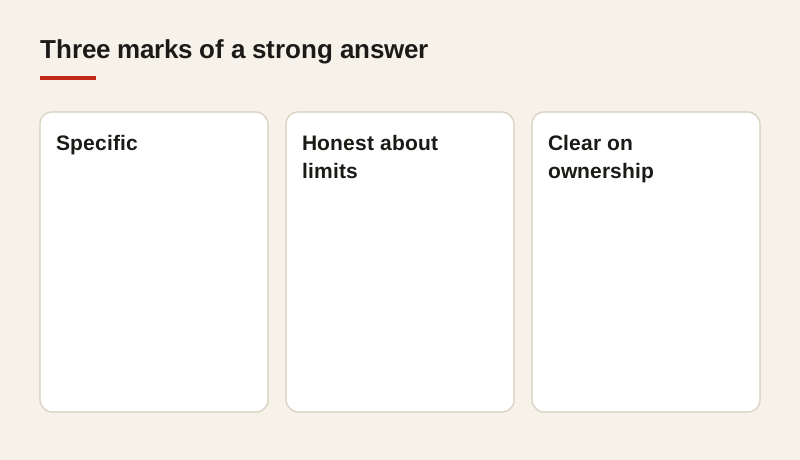
A good partner answers these questions with specifics. They name the people involved, explain what they’ll check first, show a sample report, and say plainly what they can’t promise. They also tell you when something won’t work for your store, even if it means fewer sales for them.
Watch for patterns in the answers. A partner who is clear about limits usually reports honestly when things go wrong. One who avoids specifics on every question is harder to trust later.
Red flags to watch for
- A guaranteed first-page ranking, or a guaranteed number of links.
- A price offered before anyone has looked at your store.
- Reports that show only traffic totals, with no link to sales.
- A contract that makes it hard to leave or keeps your data with them.
- No clear answer about who does the work.
Questions about pricing and scope
Ask how the price is set. A fixed monthly fee can be sensible for ongoing work, but it should be tied to a written list of what the fee includes. Ask which tasks are included, how many pages are covered, and what happens when the store adds a large new section or launches a new site. A price that can’t be explained in terms of work is hard to judge.
Ask also about one-off work, such as a technical audit, a rewrite of product pages or a migration to a new platform. Those tasks are often billed separately, and the scope should be agreed in writing before anything starts. A partner who is clear about scope will also tell you when a request falls outside the current plan, rather than absorbing it quietly and charging for it later.
Questions about your team and your platform
Ask whether the agency has worked on your platform before, such as Shopify, WooCommerce or BigCommerce. Platform knowledge matters because each one handles pages, redirects, apps and themes differently. An agency that knows the platform can avoid common mistakes, and it can point you to the fixes that are specific to your store.
Ask who on the team has the technical skill to make changes, and who you’ll need to involve for work that requires a developer. A good agency tells you clearly when a task needs your web developer or your platform support, and it doesn’t pretend to handle everything itself. Honest handoffs protect your site, and they make it easier to plan the work.
Questions to ask yourself after the first call
After the first call, write down what you learned. Did the agency explain the work in terms you understood? Did they ask about your products, your margins and your buyers, or did they talk only about rankings? Did they mention what they wouldn’t do? A good first call often leaves you with more questions than you started with, because the work has become clearer.
Compare two or three agencies using the same questions, and use the written answers rather than memory. The agency that answers most specifically, and that admits the limits of what it can promise, is usually the one to trust with your store.
Where to start with us
Book a free call and we’ll review your store. We come back with a written plan before we talk about price, so you can use the questions above and check our answers against the plan. Ask us the same questions you’d ask anyone else, and expect straight answers.
Frequently asked questions
How much should an ecommerce SEO agency cost?
Prices vary with the size of the catalog, the platform and the amount of work. The right question is not the lowest price but what the fee includes, who does the work and what you receive each month.
How long should I commit to an SEO agency?
Six months is a reasonable minimum for most stores, because the first fixes take time to show. Avoid long contracts before you have seen a sample report and a written plan.
Should I hire a specialist for Shopify or WooCommerce?
Platform experience matters. A partner who knows how your store’s theme, apps and redirects behave will avoid costly mistakes and move faster.
What should I do if my current agency will not explain its work?
Ask for a written list of the last three months of changes, with the reason for each. If the answer is still vague, it’s a sign the reporting needs to change, or the relationship does.