
Three terms come up constantly in search right now: SEO, AEO and GEO. They overlap, and they’re often used as if they mean the same thing. For an online store, they’re related but not identical, and the difference matters when you decide where to spend time.
This article explains each one in plain language, shows what they share, and gives you a first practical step that doesn’t need a large budget.
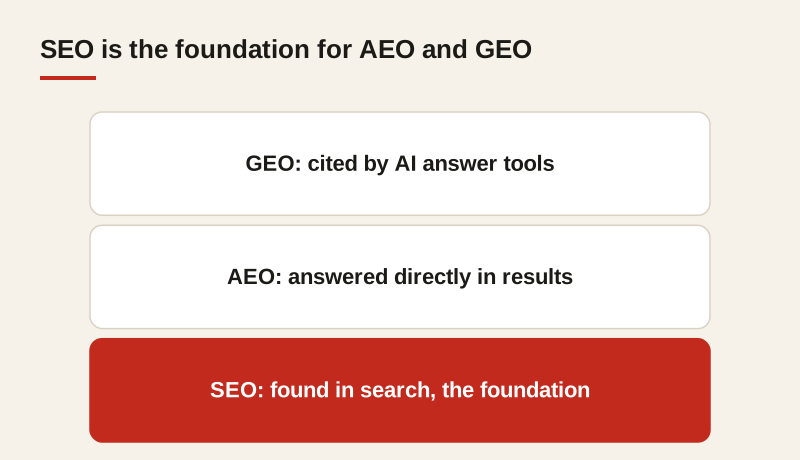
SEO: getting found in search results
Search engine optimization is the work of making a store findable in Google’s results. It covers how the site is built, how the pages are written, which pages link to which, and whether other sites trust the store enough to link to it.
SEO is still the foundation. Nothing in AEO or GEO works if Google can’t read the pages, or if the pages are too slow and confusing for a buyer to use. Most of the time, the work that helps AEO and GEO is the same work that helps SEO.
AEO: answering questions directly
Answer engine optimization is about making a store’s content easy to use as a direct answer. Google sometimes shows a short answer at the top of results, and AI tools answer questions in their own words. AEO means writing pages that answer specific questions clearly, so those answers can be pulled from your site.
For a store, that usually means clear product facts, short answers to common questions and structured information such as sizing, materials and compatibility. The aim is to make the answer easy to find and easy to trust.
GEO: being cited by AI answer tools
Generative engine optimization is about how AI tools such as ChatGPT, Perplexity and Google’s AI features choose which sources to mention. These tools tend to cite sources that are clear, specific and trusted across the web.
GEO is newer and less predictable than SEO. No one can promise a placement in an AI answer, and anyone who does is overselling. What you can do is make your store easy to understand, and make sure other reliable sites mention it. Those are the same things that build a store’s reputation with buyers, so the effort isn’t wasted even if the AI results change.
What changes for an online store
Most of the work overlaps. The same fixes that help a page rank also help it be quoted. The main differences are in emphasis and in the kind of content you write.
- Clear product facts. Specifications, sizing and compatibility written plainly, in one place, on the product page.
- Real answers to real questions. Buying guides and FAQs that answer the question directly, in the first few lines.
- Trust from other sites. Mentions and links from publications and directories your buyers already use.
- Consistency. The same product facts on the product page, in the feed, and on any other page that mentions them.
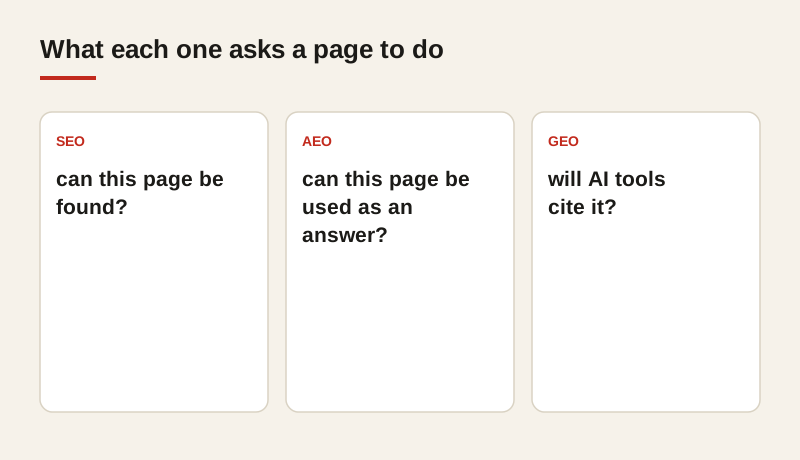
SEO asks, “Can this page be found?” AEO and GEO ask, “Can this page be used as an answer?” A store that does both well can be found, understood and quoted.
Why product facts matter more than ever
AI tools need facts they can check. A product page that says “great for beginners” tells them very little. A page that states the club length, the loft, the materials and the compatible models gives them something specific to quote, and gives the buyer something specific to compare.
This is also why consistency matters. If the product facts differ between the product page, the feed and the manufacturer’s listing, a tool may not know which to trust. Pick one source of truth for each product, and keep the others matched to it.
What to do first
Start with what you already have. Choose your ten most important product or category pages, and check three things:
- Does the page state the key facts clearly, near the top?
- Does it answer the questions a buyer would ask before purchasing?
- Is the same information consistent across the store?
Then ask an AI tool the questions your buyers ask about your category, and see which stores it mentions. Write down what it says, and which sources it names. That gives you a baseline. Repeat the check every month, and note what changes.
A simple test you can run this week
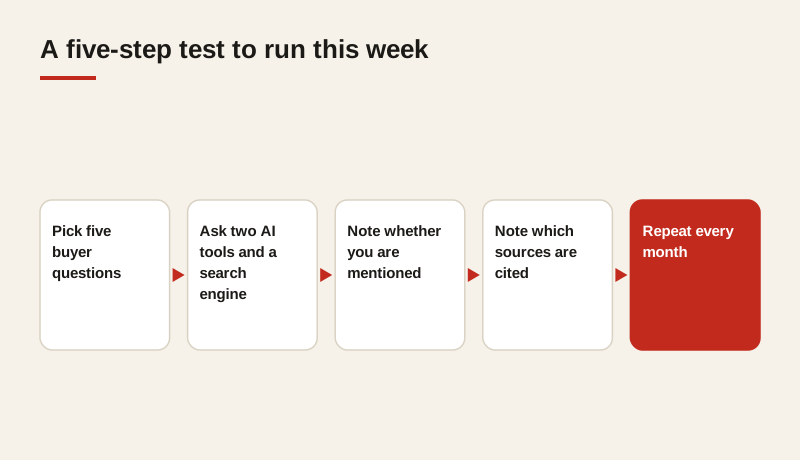
Pick five questions a buyer would ask about your category. Ask each one to two AI tools and a normal search engine, and write down the answers. For each answer, note whether your store is mentioned, which competitors appear, and which sources are cited.
Most stores find two things. First, the answers are often generic, which gives you room to be more specific. Second, the sources that are cited are often publications and directories, which tells you where to work on trust.
Where AEO and GEO fit in the plan
For most stores, AEO and GEO are part of the SEO plan, not a separate project. The fixes that help a page rank, such as clear titles, structured product facts and useful answers, also help it be quoted. We include that work in the plan, and we track it each month alongside rankings and revenue.
We can’t promise a placement in an AI answer, and nobody honest can. We can make your store easier to find, understand and cite, and we’ll show you the results honestly, including the questions where you’re still not mentioned.
What not to do
Avoid anyone who sells AEO or GEO as a guaranteed result, or as a separate product that replaces basic SEO. Avoid tricks that try to force an AI tool to repeat your claims, such as hidden text or artificial reviews. Those approaches tend to fail, and they can damage a store’s reputation with both search engines and buyers.
The sensible approach is the same one that works for good SEO: be clear, be specific, be consistent and be trusted. That’s a practical plan, and it’s one you can measure.
Frequently asked questions
Do I need a separate strategy for AEO and GEO?
Usually not. Most of the work that helps a page rank also helps it be used as an answer or cited by AI tools. Treat AEO and GEO as part of the SEO plan, and measure them alongside rankings and revenue.
Can I guarantee my store will appear in AI answers?
No honest partner can. AI tools change how they choose sources, and no one controls the result. You can make the store clearer, more specific and more trusted, which improves the odds over time.
What is the quickest thing I can do this week?
Pick ten important product or category pages and check that the key facts are stated clearly near the top. Then ask two AI tools the questions your buyers ask, and record which stores and sources they mention.
Is AEO a replacement for SEO?
No. AEO and GEO depend on the same foundations: pages that can be found, read and trusted. A store without solid SEO will struggle to appear in direct answers or AI citations.